
From vulnerability to incident: how GRC supports risk management in critical infrastructure
Organisations invest in vulnerability scanners, EDR, penetration testing and regular security audits. Yet cybersecurity incidents are not decreasing. The problem usually is not a lack of vulnerability information, but difficulty determining which weaknesses pose the greatest operational threat.
A list of detected vulnerabilities alone does not reveal the consequences of exploitation. Combining technical information with business risk assessment enables appropriate remediation priorities. This is where Governance, Risk & Compliance (GRC) helps.
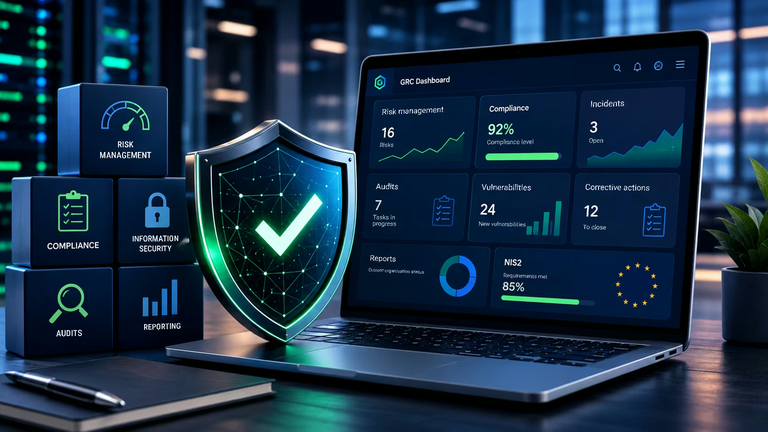
A GRC system links vulnerabilities to assets, business processes, risk owners and applicable requirements such as NIS2, ISO 27001 and ISO 31000. This helps an organisation move from reactive patching to informed risk management.
Why does a vulnerability not necessarily mean high risk?
Every day, vulnerability management tools discover security weaknesses identified by CVE references and rated using CVSS. Large organisations may have hundreds or thousands.
A high CVSS score does not always mean the highest business priority. More important questions are:
- which system is affected,
- which business processes the asset supports,
- whether additional controls reduce risk,
- what exploitation would mean for the organisation.
Only analysing this information reveals the actual risk level.
How does GRC connect vulnerabilities, risk and incidents?
In many organisations, vulnerability, incident, audit and compliance data resides in separate systems. Each team works from its own reports, making consistent decisions harder.
A GRC system integrates the information in one place. This enables:
- linking vulnerabilities to the risk register,
- assigning risk and remediation owners,
- determining the impact on business processes,
- monitoring corrective action delivery,
- reporting risk levels to management.
A vulnerability then becomes part of risk management rather than a purely technical problem.
Vulnerability management: a practical example
Hypothetical example, not a customer implementation. Consider a CVSS 9.8 vulnerability detected on a server supporting a water utility’s SCADA system.
Technically, it is a critical security weakness. Risk analysis reveals that the server controls the water treatment process. Successful exploitation could therefore disrupt public service continuity.
In this case, remediation priority follows not only from technical severity, but above all from the potential operational impact.
Operational risk management as part of cybersecurity
Effective vulnerability management requires a wider context than IT infrastructure alone.
Operational risk management includes business processes, people, suppliers, IT systems and their dependencies. This is particularly important in critical infrastructure, where cyberattack consequences can extend far beyond technology.
Operational risk analysis helps identify which vulnerabilities genuinely need immediate action.
Why does RCSA help prioritise vulnerabilities?
Risk & Control Self-Assessment (RCSA) evaluates risk from business process owners’ perspective.
RCSA enables an organisation to:
- assess existing control effectiveness,
- identify areas needing further action,
- assign risk accountability,
- track risk levels over time.
It translates technical data into language understood by the board and those responsible for business continuity.
How does reporting support risk management?
Inconsistent reporting is a common problem.
A vulnerability report shows new weaknesses, remediation speed and areas requiring additional work. An incident report helps assess control effectiveness and organisational response times.
Connecting this information to the risk register enables management to decide based on actual threat levels, not merely the number of detected vulnerabilities.
Why is GRC software becoming more important?
As systems, vulnerabilities and regulatory requirements multiply, manual information management becomes inefficient.
GRC software can help organise information and prepare management summaries. Check automation, change history, notifications and reports in the specific solution.
Organisations can consequently respond faster to threats and prepare more effectively for audits and inspections under NIS2 or ISO 27001.
Common vulnerability management mistakes
Typical problems are:
- assigning all vulnerabilities the same priority,
- failing to link vulnerabilities to business risk,
- no owners responsible for remediation,
- no monitoring of control effectiveness,
- data scattered across multiple tools.
Organisations then spend resources resolving less important vulnerabilities while genuinely critical threats remain unaddressed.
Summary
Effective vulnerability management is not about fixing every detected weakness at the same pace. It is about understanding which vulnerabilities could genuinely affect operations.
Connecting vulnerability management to GRC enables business-context risk assessment, appropriate prioritisation and more effective incident reduction. Organisations integrating technical data with risk analysis and reporting are better prepared for both cyber threats and requirements such as NIS2 or ISO 27001.