What is a GRC system?
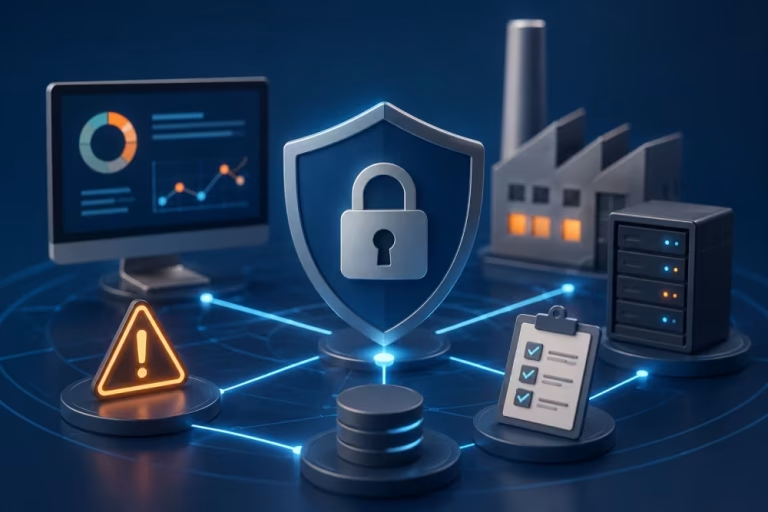
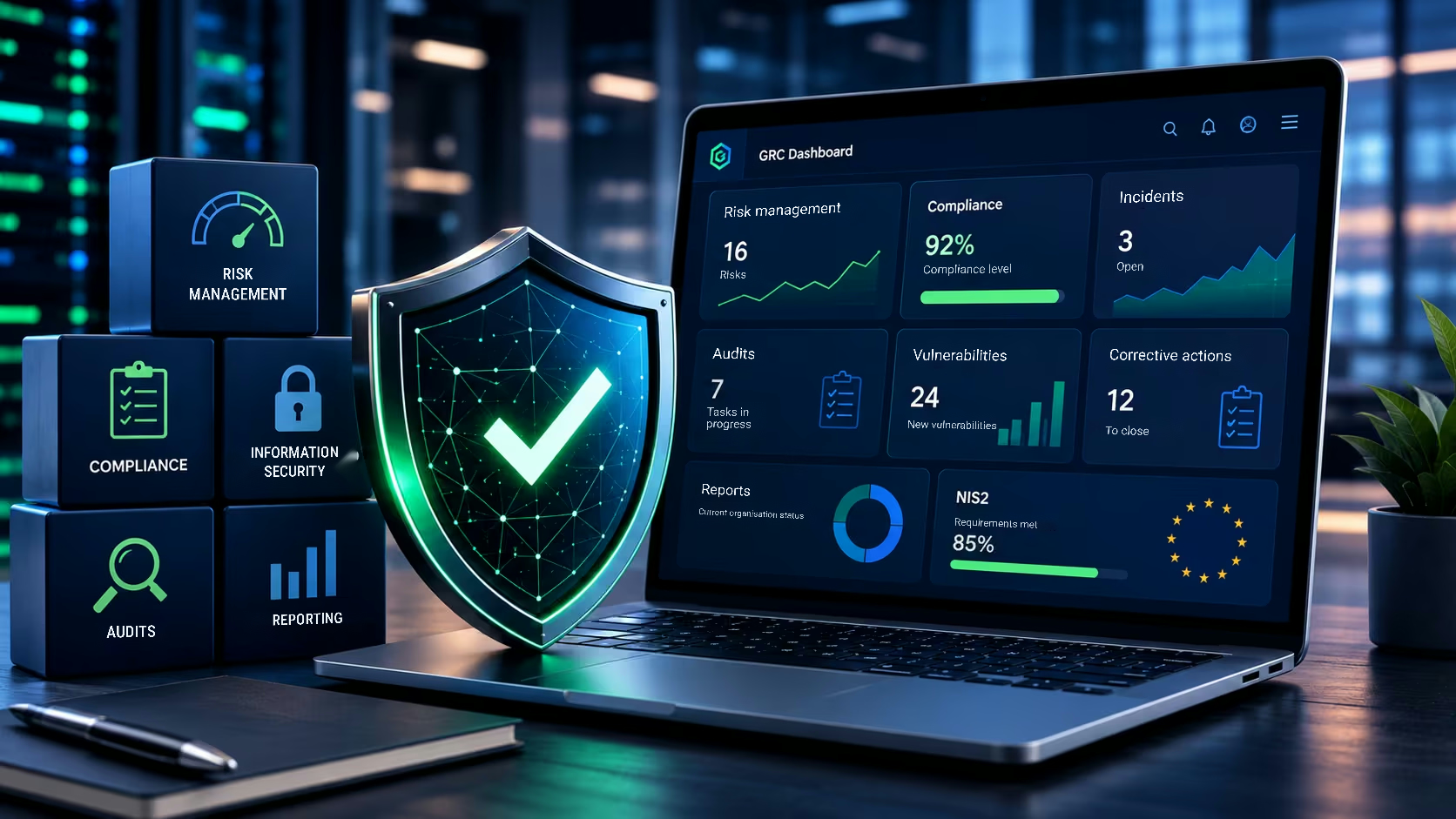
GRC software combines organisational governance, risk management and regulatory compliance in one platform. Instead of separate spreadsheets for risks, audits, incidents and documentation, the organisation has one system connecting this information.
In practice, a GRC system supports risk management, regulatory compliance monitoring, audits, incident handling and reporting. Organisations no longer need numerous scattered Excel spreadsheets and separate applications.
A modern platform also supports collaboration between IT, security, compliance, audit and management, providing a single coherent picture.
Further reading: What Is GRC? A Complete Guide to Governance, Risk & Compliance.
Why do organisations implement GRC systems?
Only a few years ago, many organisations maintained risk registers, compliance activities and audit findings in separate documents. Regulations such as NIS2 and DORA have made this approach increasingly inefficient.
GRC systems are therefore adopted not only by large businesses, but also by medium-sized organisations and public entities.
Common reasons include:
- centralising risk information,
- managing regulatory compliance,
- automating compliance processes,
- monitoring remediation,
- conducting audits,
- management reporting,
- preparing for NIS2 and ISO 27001.
The organisation gains better process control and responds faster to emerging threats.
How does GRC software work?
Modern GRC software gathers information from different organisational areas and presents it in one place. Security and compliance teams can analyse data, plan action and monitor progress faster.
Typical modules include:
- risk management,
- compliance,
- vulnerability analysis,
- incident management,
- audits,
- remediation,
- asset inventory,
- reporting and dashboards.
GRC software can help organise information and prepare management summaries. Check automation, change history, notifications and reports in the specific solution.
What are the benefits of a GRC platform?
A GRC platform benefits both operational teams and management.
The main advantages are:
- structured risk management processes,
- easier compliance management,
- better action delivery control,
- faster audit preparation,
- more effective reporting,
- centralised documentation,
- less manual work.
Importantly, GRC also supports decisions based on current data, rather than scattered information across different tools.
GRC software and NIS2 requirements
Preparing for new regulatory requirements is a major reason for implementing GRC.
NIS2 requires risk management, compliance monitoring, documentation and incident reporting. Although no specific IT system is mandated, GRC greatly simplifies these obligations.
Organisations can identify non-compliance faster, track implementation progress and prepare reports for management and auditors.
What should you consider when choosing GRC software?
Many platforms are available, but not every solution suits every organisation. Define business needs and applicable regulatory requirements before selecting a system.
A good GRC system should support users’ daily work rather than create extra administration.
Consider:
- centralised risk management,
- compliance process support,
- support for NIS2, ISO 27001 and DORA,
- vulnerability and incident management,
- audit capabilities,
- process and workflow automation,
- clear reports and dashboards,
- ease of configuration and expansion.
Also check integration with existing systems. This prevents scattered data and keeps processes consistent.
How to assess GRC platform functionality
Use your own examples rather than relying on feature lists. Three organisational scenarios and one demonstration using realistic sample data are enough.
| Area | Checklist question | How to test it in a demonstration |
|---|---|---|
| Risk register | Does every risk have an owner, deadline, treatment plan and review date? | Ask to add one risk and assign it to an asset and process |
| Relationships | Can dependencies between service, process and asset be established? | Ask to see the available way of documenting relationships, without assuming a graph |
| Incidents | Can an incident and a personal data breach be handled in one record? | Follow one incident from report to closure |
| Statutory deadlines | Can the tool help document applicable deadlines and exceptions? | Check 24 and 72 hours from detection and one month from notification for a significant incident under the general regime; see FAQ for exceptions |
| Suppliers | Do contracts, certificates and supplier risk assessments have dates and reminders? | Add a supplier with a contract expiring in one month |
| Audit | Do audit findings generate corrective actions with owners? | Close one non-conformity through an action |
| Reports | Are management reports generated from system data? | Generate a management review or PDF report |
| Data | Where is data held, and can it be exported? | Ask about server locations, Excel and PDF export and the data processing agreement |
Also ask who answers questions after implementation and within what timeframe.
Integrating risk and compliance: which GRC integrations matter?
GRC integrations serve one purpose: avoiding manual data re-entry. Four connection types are particularly useful.
- Public registers. CyberSonar24 retrieves company data from Poland’s GUS using the NIP tax identifier.
- CyberSonar24 supports vulnerability imports from NVD/CVE. Check supported formats, scanner sources and update frequency for the chosen deployment.
- User directory. CyberSonar24 supports user synchronisation with AD/LDAP. Agree the deployment scope without assuming single sign-on or a particular plan.
- Files and reports. Verify supported import, export and report formats using your own example for the chosen deployment.
Before purchase, check which integrations work immediately and which need a separate project.
How to request GRC implementation support
Risk management implementation support is usually purchased with the platform in four steps. This sequence avoids buying a tool whose scope does not match your obligations.
- Start by identifying obligations and gaps. CyberSonar24 Audit Zero is an initial self-assessment, not a statutory audit, certification or confirmation of compliance. Check the service terms before use.
- Demonstration using sample data. The provider shows your scenarios in the system, as outlined in the table above.
- Select delivery model and support scope. Cloud service or installation on organisational servers; number of units; team training; support with initial registers.
- Contract and implementation plan. Include a schedule, responsible people on both sides and a data processing agreement.
Agree CyberSonar24 training and support in the contract after a demonstration. Book a demonstration form.
Where should a medium-sized organisation in Poland source a risk and compliance platform?
Choose a provider that understands Polish regulations and can demonstrate your use case before contract signature. Medium-sized organisations in Poland should check five conditions:
- Polish-language software and documentation using the terminology of Poland’s national law implementing NIS2 (KSC) and GDPR,
- deployment in the cloud or on the customer’s own servers (on-premises), with processing locations agreed in the contract,
- a personal data processing agreement,
- a VAT invoice and support for public institution purchasing,
- a demonstration and trial environment before purchase.
CyberSonar24 can support risk management and compliance. It runs in the cloud or on the customer’s own servers (on-premises). Agree deployment scope and processing locations in the contract. See sectors covered by Poland’s NIS2 implementing law, with detailed examples for hospital risk and compliance software and water utilities.
How to verify reviews of risk and compliance platforms
The most credible feedback comes from an organisation similar to yours that uses the system daily. Online ratings rarely address Polish regulations and the public sector.
Before choosing a platform:
- ask the provider for a contact in the same sector, with that organisation’s consent,
- ask who runs the system at that customer and how much time it takes,
- test the trial environment yourself rather than relying solely on a demonstration,
- verify that reviews concern the same version and deployment model.
Common GRC selection mistakes
A GRC platform is a long-term investment. The decision should not rely only on price or feature counts.
Common mistakes include:
- selecting a system without analysing organisational needs,
- focusing only on the current project,
- no expansion capability,
- an overly complex interface,
- no process automation,
- overlooking integrations,
- insufficient reporting capabilities.
The organisation then uses only part of the functionality, and the system does not effectively support risk and compliance management.
Who is GRC software for?
Modern GRC software serves both public and private sectors. Users now include medium-sized organisations preparing for new regulations, not just the largest businesses.
Typical users are:
- operators of essential services,
- entities covered by NIS2,
- hospitals and healthcare providers,
- public administration bodies,
- manufacturers,
- energy companies,
- digital service providers.
A GRC platform is useful wherever risk, compliance and information security need to be connected.
CyberSonar24 offers modules for GDPR, GRC (NIS2/KSC), AI Act, DORA and ISO/IEC 27001. Fit with a particular organisation’s obligations requires separate assessment. Sector information: public administration. Two detailed examples are hospitals and water utilities.
A GRC use case
Hypothetical example, not a customer implementation. An organisation is preparing to meet NIS2 requirements. IT maintains a vulnerability register, quality owns documentation and compliance teams monitor legislative change. The benefits described are assumptions of the example, not measured customer outcomes.
Each team uses different tools. Management reporting consequently requires manual data collection from multiple sources.
After implementing GRC software, all risk, compliance, vulnerability, incident and remediation information enters one platform. Decisions become faster, task monitoring more effective and audit preparation easier.
Summary: is GRC software worth implementing?
Growing regulatory requirements and cyber threats make spreadsheet-based risk and compliance management increasingly inefficient.
GRC software can help organise information and prepare management summaries. Check automation, change history, notifications and reports in the specific solution.
Select a platform not just by feature count, but also by scalability, usability and organisational fit. A well-implemented solution supports daily teamwork and the requirements of NIS2, ISO 27001 and DORA.