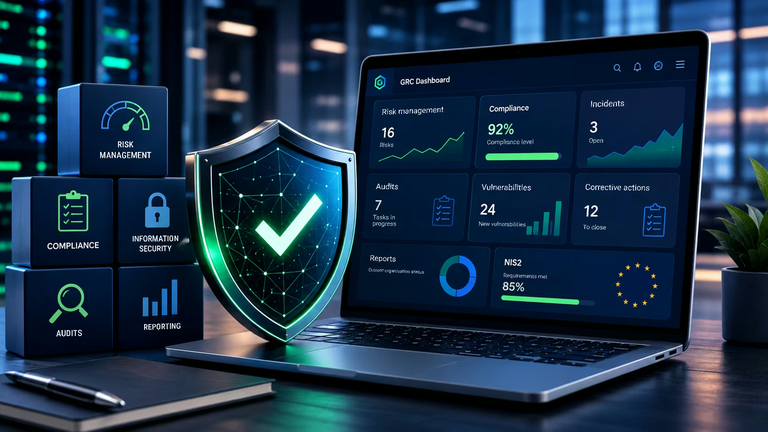
GRC (Governance, Risk and Compliance) is an approach that combines organisational governance, risk management and regulatory compliance in a single process. These three areas are managed together using shared principles and data, rather than in separate departments and spreadsheets.
In practice, GRC means that management defines objectives and accountability (governance), the organisation assesses what could threaten those objectives (risk), and checks whether it meets legal and standards-based obligations (compliance). These include Poland’s national law implementing NIS2 (KSC), the NIS2 Directive, the DORA Regulation and ISO 27001.
Only a few years ago, risk, compliance and security management usually operated in separate systems or Excel spreadsheets. Information was consequently scattered, reporting took considerable time and decisions relied on incomplete data.
Today, more organisations are implementing GRC platforms that integrate all key information in one place. These solutions are used not only by large enterprises, but also by local authorities, municipal utilities, hospitals and small and medium-sized businesses preparing for NIS2 or ISO 27001 certification.
This article explains GRC, the problems it solves, how GRC systems work and why they are becoming a central element of modern organisational management.
What does GRC stand for?
GRC stands for Governance, Risk & Compliance. Each element addresses a different organisational area. Only their combination, however, creates a coherent management model.
| Area | Meaning | Main objective |
|---|---|---|
| Governance | Organisational governance | Define accountability and management principles |
| Risk | Risk management | Identify, analyse and reduce risk |
| Compliance | Conformity with requirements | Meet legal, regulatory and internal requirements |
Although each area can operate independently, in practice separating them often creates organisational problems.
Consider an organisation with a risk register in Excel, incidents managed through a help desk, compliance documentation on a network drive and audit findings in separate files. Producing one board report requires gathering and manually processing data from multiple sources.
Modern GRC platforms therefore integrate this information in one place. This gives the organisation a complete view of risk, compliance and ongoing activities.
Why is GRC so important today?
A decade or two ago, most organisations could manage security effectively using simple tools and procedures. However, digitised business processes, cloud services and growing cyber threats have made the traditional approach insufficient.
Laws and standards may require appropriate controls and documented risk management. Distinguish legal instruments from standards, for example:
- the NIS2 Directive,
- the DORA Regulation,
- ISO 27001,
- Poland’s national law implementing NIS2 (KSC),
- GDPR,
- ISO 31000.
As a result, management needs ongoing access to information on risk levels, compliance status and remediation effectiveness.
GRC can help gather information in one place. Reporting and compliance monitoring automation depend on the chosen solution.
The three pillars of GRC
Governance: effective organisational management
The first pillar is Governance.
It covers how an organisation is managed, how decisions are made and how responsibility for individual processes is defined. Above all, governance structures roles, duties and operating principles across the organisation.
In practice, this includes:
- creating security policies,
- defining process owners,
- approving procedures,
- monitoring progress towards objectives,
- overseeing conformity with organisational policy.
This gives management confidence that decisions follow agreed principles and accountability for individual activities is clear.
Risk: managing uncertainty and threats
The second pillar is Risk, or risk management.
Every organisation faces threats ranging from cyberattacks and infrastructure failures to human error and legislative change. Effective risk management therefore means deliberately identifying, evaluating and reducing threats, not eliminating every one of them.
The process typically includes:
- Identifying threats.
- Analysing vulnerabilities.
- Assessing the likelihood of an event.
- Assessing potential consequences.
- Determining risk levels.
- Planning risk reduction measures.
- Monitoring the effectiveness of controls.
This approach also underpins ISO 27001, ISO 31000 and NIS2 requirements.
Compliance: meeting requirements
The third pillar is Compliance: ensuring conformity with applicable legislation, standards, industry regulations and internal policies.
Compliance is not, however, simply preparing documentation for an audit. It is a continuous process of monitoring legislative changes, identifying non-compliance and planning remediation.
A modern compliance system supports:
- regulatory requirements monitoring,
- gap analysis,
- assigning accountability,
- corrective action management,
- compliance reporting.
Management consequently receives current information on progress against NIS2, DORA or ISO 27001 obligations and can respond faster to non-compliance.
How does a GRC system work?
A GRC system connects information from different organisational areas rather than merely storing documents. Check which operations require user work and which the tool can support automatically.
A GRC platform acts as a central management point for organisational risk, compliance and security.
In practice, each new vulnerability, security incident, audit finding or legislative change can be linked to a specific business process, risk owner and remediation action. The organisation therefore manages events effectively rather than merely recording them.
An example workflow is:
- A vulnerability is detected.
- The system assigns it to the relevant asset or process.
- Its impact on risk is analysed.
- An owner is assigned to resolve the issue.
- Remediation is planned.
- The board receives an up-to-date risk report.
Connecting these elements is what distinguishes GRC platforms from ordinary task management systems.
Which processes does a GRC platform support?
Modern GRC platforms develop alongside the organisation. Most solutions therefore extend beyond a single module and cover multiple security and compliance-related business processes.
Common modules include:
| Module | Purpose |
|---|---|
| Risk management | Identify, assess and monitor risk |
| Risk register | A central database of all organisational risks |
| Compliance | Monitor conformity with legislation and standards |
| Vulnerability management | Record and prioritise vulnerabilities |
| Incident management | Handle security incidents |
| Audits | Plan and document audits |
| Remediation | Monitor implementation of recommendations |
| Dashboards | Management reporting |
Custom forms, workflows and reports depend on the specific solution. Check configuration options before choosing a system.
Why is Excel no longer enough?
For years, spreadsheets were the main tool for managing risk and compliance. They offered a quick, inexpensive solution for small organisations.
As processes increase, however, limitations emerge that spreadsheet changes alone cannot resolve.
Common problems include:
- multiple versions of the same document,
- no change history,
- manual reporting,
- difficulty tracking deadlines,
- no links between risks, incidents and vulnerabilities,
- no automatic notifications,
- data scattered across multiple files.
The organisation therefore spends more time managing documentation than actually reducing risk.
A comparison highlights the differences.
| Excel | GRC platform |
|---|---|
| Data in multiple files | One central database |
| Manual reports | Summaries depend on the solution |
| No workflows | Process support depends on the solution |
| No change history | History depends on the solution |
| Difficult collaboration | Multiple users working simultaneously |
| No connections | Linked risk, incidents and compliance |
A shared dataset can facilitate collaboration and report preparation. Information stays current through updates and reviews, while access depends on agreed permissions.
GRC and risk management
One of the most important uses of GRC platforms is risk management.
Many organisations assess risk once a year, usually before an audit or management review. Modern threats, however, change almost daily.
Modern GRC systems therefore enable continuous risk management.
A new vulnerability, incident or legislative change should trigger a user review of risk. CyberSonar24 recalculates the value on saving the record as likelihood × impact.
For example:
- a new CVE vulnerability emerges,
- the user establishes which assets are affected,
- the user updates the assessment and saves the risk record,
- the risk owner reviews the result,
- the user plans and documents remediation actions.
Document the review so decisions and changes can be reconstructed during an audit. Check the history available in the tool.
GRC and compliance
Compliance is often associated only with documentation and audit preparation. Its role is actually much broader.
A GRC system can support tracking of legal, standard and policy requirements. Check responsibility assignment, deadline tracking and reporting in the specific solution.
For example, an organisation can monitor compliance simultaneously with:
- NIS2,
- ISO 27001,
- DORA,
- Poland’s national law implementing NIS2 (KSC),
- GDPR,
- internal security policies.
The board receives one coherent report rather than several independent summaries from different departments.
GRC and NIS2
Finally, why is GRC so frequently discussed in relation to NIS2?
The new rules require appropriate security measures and documentation of the risk management process.
This is where GRC platforms demonstrate their greatest value.
A GRC system supports:
- maintaining a risk register,
- documenting remediation,
- monitoring compliance levels,
- managing incidents,
- management reporting,
- audit preparation.
Importantly, the platform does not implement NIS2 on the organisation’s behalf. It does, however, make managing the required processes and documenting delivery significantly easier.
Summary
GRC (Governance, Risk & Compliance) is much more than another IT tool. It is a comprehensive approach to organisational management integrating governance, risk management and regulatory compliance.
NIS2 and DORA are EU legal instruments; ISO/IEC 27001 is an information security management system standard. Any duty to apply it or obtain certification must be established separately for the organisation.
Implementing a GRC platform is not just about buying software. Structured processes, clear accountability and a coherent management model are essential. A properly implemented solution reduces risk, streamlines reporting and improves the effectiveness of cybersecurity and compliance activities.
If your organisation is preparing for NIS2, planning ISO 27001 certification or seeking to structure risk management processes, consider a modern GRC platform that supports teams’ daily work and gives management current information for decision-making.