


Incidents and risk events
Registration, classification and notification of an incident
Registration, classification and handling of incidents. Personal data breaches sit in the same module.

We help raise the cybersecurity posture of organisations with CyberSonar24.


01 · Platform modules
CyberSonar24 is made of modules that share the same registers. An asset entered once is visible in the risk assessment, in an incident, in the business continuity plan and in the record of processing activities. You start with what the Act requires, and you add further areas without moving data.
Platform products
01
Identification, assessment and monitoring of risks against assets and processes, a risk matrix and periodic reviews.
02
Systems, devices and information together with the processes that depend on them, and a dependency graph.
03
Criticality analysis of processes with an acceptable downtime and an acceptable data loss, business continuity and disaster recovery plans aligned with ISO 22301, and a test schedule with reminders.
04
Registration, classification and notification of an incident. Personal data breaches in the same module.
05
Vulnerabilities from the NVD linked to the asset, criticality assessment and remedial actions.
06
Assessment and monitoring of suppliers across the supply chain, and tracking of certificates.
07
An audit programme, recommendations, corrective actions and a management review.
08
Actions arise from risks, vulnerabilities and statutory requirements. Each has an owner and a deadline, and progress is visible as it happens.
09
A central place for policies, procedures, instructions and management-system documentation.
10
An e-learning portal with a test and a certificate, training assigned to roles, and the training level visible to the leadership.
11
A record of the access-rights matrix and access-control policies.
12
Tracking of all deadlines, audits, tests and reviews.
Integrations. Organisation and supplier data from public registers (GUS), a daily check of the NVD vulnerability database, import of assets and suppliers from Excel files, export to Excel and PDF. In an installation on the organisation’s servers, also Active Directory. (applies to Polish companies only)
Specification02 · Measurable results of implementation
The Polish act implementing NIS2 (KSC) (Dz.U. 2026 poz. 252) sets obligations and deadlines for essential and important entities in every sector. In CyberSonar24 each of them has its place: a register, a responsible person and a reminder.
Significant incident
24 h
The first information about a significant incident. The incident is recorded in one module, and the system prompts a notification to the CSIRT team when it concerns an essential service.
72 h
The notification template and the incident’s links to assets, processes, risks and suppliers are at hand. An important entity that is a public entity submits only the notification within 72 hours (art. 12c).
1 month
The deadline for the final report on handling a significant incident under the Polish act implementing NIS2 (KSC).
Statutory deadlines
3.10.2026
The deadline to apply for entry for entities that met the criteria on 3.04.2026. Later: 6 months from meeting the criteria. Public entities are entered ex officio.
3.04.2027
Registers of assets, risks and suppliers and business continuity plans with documentation in one repository, with versions and a change history.
3.04.2028
Essential entities: the first security audit (art. 33 para. 2 of the amending Act), then at least once every 3 years. An audit programme, ISO 27001 checklists and corrective actions from nonconformities.
10
Each of the ten risk-management areas from Article 21 of the NIS2 Directive, transposed into the Polish act implementing NIS2 (KSC), assigned to a system module.
30 days
before a supplier contract expires and before a scheduled audit: a reminder for the owner
14 days
before a business continuity plan test and before a management review: a reminder
7 days
before a remedial-action deadline: a reminder
1 year
the longest interval between policy reviews in the document repository
03 · Close-ups
Incidents and risk events
Registration, classification and handling of incidents. Personal data breaches sit in the same module.
Internal audits and compliance
An audit programme, control paths, recommendations and corrective actions, and compliance reports for NIS2 and the Polish act implementing NIS2 (KSC). The management review documents the accountability of the leadership.

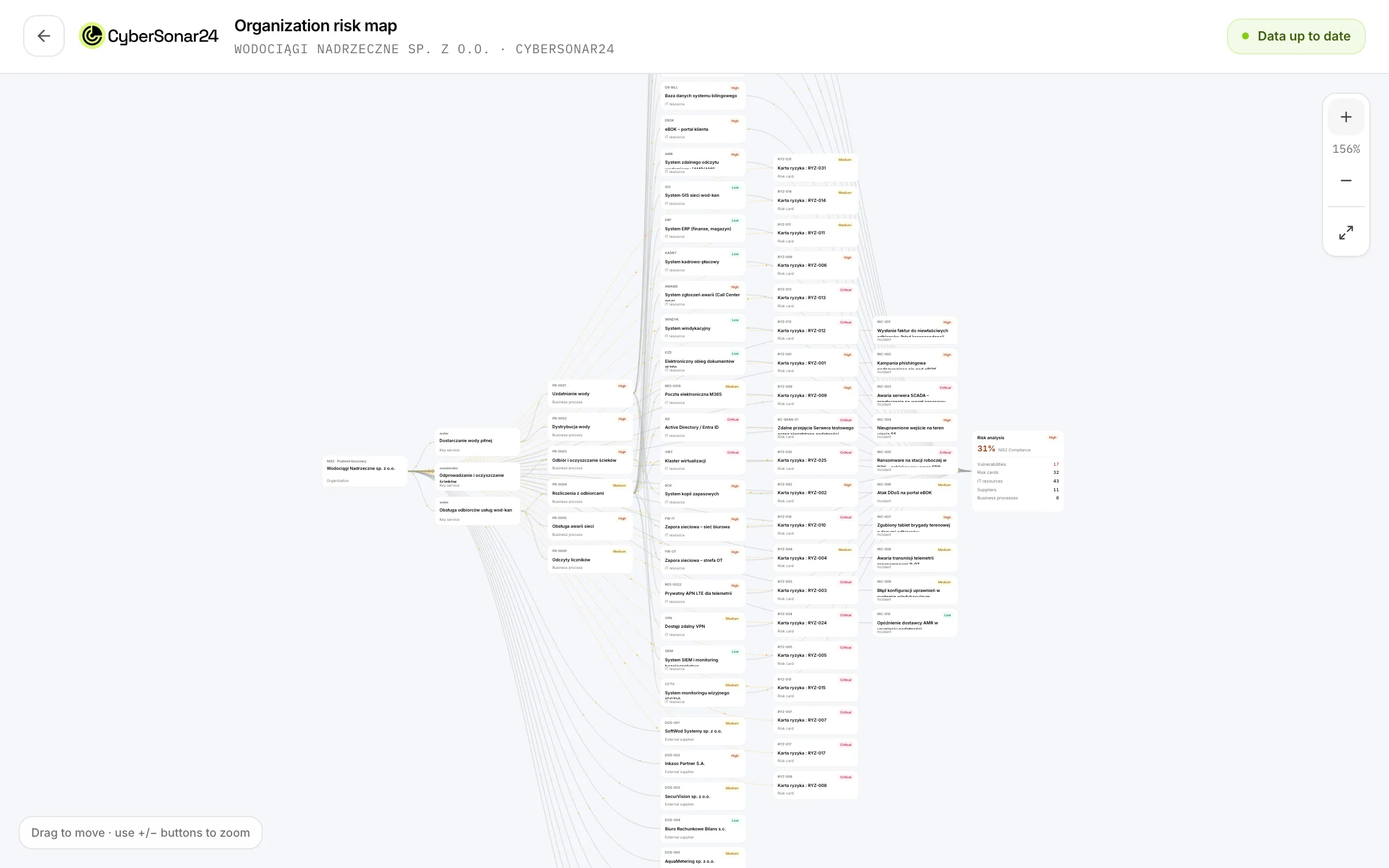
Asset inventory and classification
A record of systems, devices and information together with the processes that depend on them. The dependency graph shows how a failure of one element affects essential services.
04 · Who it is for
The Polish act implementing NIS2 (KSC) (Dz.U. 2026 poz. 252) covers essential and important entities from the sectors listed in two annexes, as well as public entities. The obligations are shared: a security management system with documentation, handling and reporting of incidents, and supplier-risk management. CyberSonar24 runs them in one system, regardless of sector.
Questions and answers
The Act applies to essential and important entities, that is organisations operating in the sectors listed in Annexes 1 and 2 to the Act (Dz.U. 2026 poz. 252) that meet its criteria, above all the size criterion. Public entities are among them.
The final classification should be confirmed with a lawyer. A first step can be the free Audit Zero: the questionnaire does not require an account, and a PDF report is sent to the email address you provide.
The category is decided above all by the sector and the size of the organisation. For planning the work, the most important difference concerns the audit. An essential entity carries out its first security audit of the information system by 3 April 2028 (art. 33 para. 2 of the amending Act), and subsequent audits at least once every 3 years (art. 15 para. 1). An important entity carries out an audit only when the authority orders one by decision (art. 15 para. 1b).
Both categories must have a security management system with documentation by 3 April 2027, and both report significant incidents within 24 hours, 72 hours and one month. An important entity that is a public entity submits only the notification within 72 hours (art. 12c). The name of the annex (“essential sectors”, “important sectors”) describes the sector, not automatically the category of the entity.
Are you unsure whether the organisation is subject to the Act and in which category? Free Audit Zero does not require an account, and a PDF report is sent to the email address.
Free Audit ZeroThe name of the annex describes the sector. Whether an organisation is an essential or an important entity is decided above all by the type of activity and its size. A first picture is given by the free Audit Zero.
05 · Obligations under the Polish act implementing NIS2 (KSC)
The risk-management measure areas from Article 21 of NIS2, transposed into the Polish act implementing NIS2 (KSC), and the modules in which you carry them out in CyberSonar24.
| Point | Area | CyberSonar24 modules |
|---|---|---|
| a) | Risk analysis and security policies | Risk analysis, Document repository |
| b) | Incident handling | Incidents, Actions |
| c) | Business continuity and crisis management | Business continuity plan, Impact analysis |
| d) | Supply-chain security | Suppliers |
| e) | Acquisition and maintenance of systems, vulnerabilities | Vulnerabilities, Organisation assets |
| f) | Effectiveness of measures | Audits, Recommendations, Management review |
| g) | Cyber hygiene and training | Training |
| h) | Cryptography and encryption | Document repository (policies) |
| i) | Human resources and access control | Access-rights matrix |
| j) | Multi-factor authentication | Access-rights matrix |
06 · How it works
The platform takes you through the obligations of the Act in the order in which a security management system is built. Each step uses data from the previous one.
01
Essential services, processes, assets and suppliers go into one system, including from Excel files. The dependency graph shows what a failure of one element will stop.
02
A risk assessment is built on the registers. Each risk has an owner, a treatment plan, a deadline and a review date.
03
You run incidents, remedial actions, training, access reviews and continuity-plan tests in one place. The system reminds you of deadlines.
04
The management review, reports for the leadership and documentation for the auditor are produced from the data in the system, with a change history.
01
A questionnaire with no account, a PDF report to the email address. It shows where to start.
02
We show the system on sample data. We agree the modules, the number of units and the installation model: a cloud in the European Union or your servers.
03
Essential services, processes, assets and suppliers go into the system, including from Excel files. A risk assessment and a treatment plan are built on that basis.
04
You run incidents, remedial actions, training and audits in one place. The leadership receives a management review, and evidence for the auditor is produced as you go.
07 · CyberSonar24 AI
Help with preparing documentation.
Book a presentation
A free presentation with no obligation, in a dedicated and encrypted environment.
Presentation request form
Thank you for your enquiry
We have received your message. We will contact you to arrange a presentation.
Free CyberSonar24 demo
We will prepare a dedicated demonstration environment for you, where you can try the asset register, risk analysis, incident handling and compliance documentation yourself. We make the environment available within 24 hours on working days, at no charge.
We will prepare a dedicated demonstration environment for you within 24 hours on working days.
