
Why do water utilities need to consider GRC today?
Water supply and wastewater activities are listed in Annex 1 to Poland’s NIS2 implementing law. Whether a particular entity is covered and its category depend on Articles 5 and 5a, including size, legal form and exceptions. A service’s societal importance does not itself establish formal critical infrastructure status.
In practice, any failure, incident or successful attack can directly affect society. Regulatory requirements, including those under NIS2, are also increasing and require a systematic approach to security.
Yet operations often still rely on scattered data, Excel spreadsheets and action taken only after a problem occurs. This not only makes regulatory compliance harder, but significantly increases risk.
This is where GRC (Governance, Risk & Compliance) comes in: an approach that structures organisational management around risk, compliance and security.
What is GRC and how does it work in practice?
GRC (Governance, Risk & Compliance) combines three key areas in one management system: organisational oversight, risk management and compliance management.
It replaces silos in which each area operates independently with a coherent system of connected information. The organisation gains a complete picture and can make decisions using data rather than intuition.
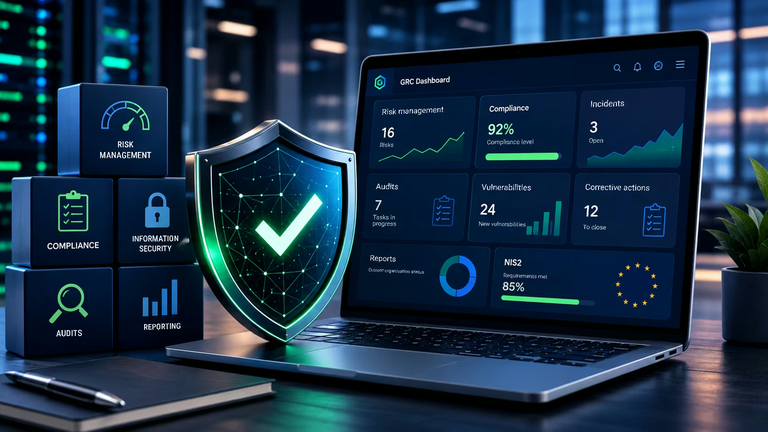
In a well-designed GRC environment, risk identification, incident monitoring, vulnerability management and remediation oversight are integrated. A risk management system underpins the approach, while a compliance management system monitors conformity with regulatory requirements, including NIS2.
NIS2 for water utilities: what actually changes?
NIS2 shifts the focus from formal security requirements to operational delivery. Documentation and procedures alone are no longer enough: organisations must demonstrate that they genuinely manage risk and control their environment.
This requires a risk-based approach covering both IT and operational systems. Incident management and supplier oversight are equally important, as suppliers are often the weakest link in the ecosystem.
Reporting also matters. The board needs access to security information and bears direct responsibility for its decisions. Data must therefore be structured, clear and current.
The law requires effective processes and appropriate controls, not the purchase of a GRC platform. Such software can help organise data, document actions and support oversight, depending on the organisation’s scale.
How do you implement risk management in a water utility?
An effective risk management system requires an understanding of the organisation and a consistent approach to maintaining the process.
The first step is risk identification. In water utilities, this covers IT and operational infrastructure, including control systems. Supplier dependencies and human factors, still a major source of threats, also need consideration.
Next comes RCSA (Risk & Control Self-Assessment). This translates identified threats into actual business impact. The organisation can establish which risks are critical, who owns them and whether existing controls are sufficient.
Identification and assessment alone are not enough. Continuous monitoring and reporting are essential to support management decisions.
Reporting as a foundation of effective GRC
A common organisational problem is inconsistent reporting. Data exists, but is scattered and difficult to interpret.
Regular GRC reports therefore play an important role in organising information and giving it context. A monthly risk report, for example, shows not just risk counts but also their composition and changes over time. Management can quickly identify areas needing intervention.
A board dashboard complements this by providing key indicators, trends and alerts. It supports the transition from reactive to proactive management.
Compliance management: meeting NIS2 requirements in practice
Many organisations still view compliance as a formal obligation. Under NIS2, however, it must be a continuous, measurable process.
Effective compliance management means continuously monitoring conformity, identifying gaps and driving remediation. This calls for a compliance management system that structures these processes and links them to risk.
Compliance reports show the organisation’s current position against NIS2 requirements, while action reports evaluate the effectiveness of initiatives. Supplier assessment is also increasingly important because supply chains often contain the most significant threats.
When should you consider GRC software?
As the environment grows more complex, organising information manually may take more work. Tool selection depends on organisational scale and process effectiveness.
GRC software can help organise information and prepare management summaries. Check automation, change history, notifications and reports in the specific solution.
These systems integrate risk, incident and vulnerability data and present it through reports and dashboards. Integration delivers the greatest value by providing a complete view of security.
Common GRC implementation mistakes
Many organisations encounter similar problems. Most arise from treating GRC as a one-off project rather than a continuous process.
Other common mistakes are a lack of board engagement and reliance on scattered tools instead of a coherent solution. The organisation then meets some requirements formally without gaining genuine risk control.
Summary
Implementing GRC (Governance, Risk & Compliance) in the water sector is more than a response to NIS2. Above all, it provides a way to strengthen organisational resilience.
Combining a risk management system, effective compliance management and GRC software structures processes, improves decisions and reduces operational risk.
NIS2 is therefore not just a regulatory obligation. For many organisations, it can be the catalyst for a real transformation in security management.