


What is risk assessment?
Risk assessment identifies threats, evaluates their impact on an organisation and determines how likely they are to occur. Its purpose is to highlight areas requiring particular protection and plan measures that reduce risk to an acceptable level.
In practice, risk assessment is one of the most important elements of information security management. Organisations use it not only to protect IT systems, but also to safeguard business processes, data and critical infrastructure. Without a thorough assessment, it is difficult to make informed decisions about security investments or remediation plans.
Risk assessment is becoming more important as new regulations emerge. The NIS2 Directive, ISO 27001 and ISO 31000 all base their requirements on a risk-based approach. Organisations should therefore not only identify threats, but also regularly monitor their impact and the effectiveness of implemented controls.
Importantly, risk assessment is not a one-off project carried out before an audit. It is an ongoing process that should be updated as the organisation changes, IT infrastructure develops and new cybersecurity threats emerge.
Why is risk assessment so important?
Every organisation makes dozens of decisions each day about security, technology and operations. Some directly affect business continuity, data security or compliance with applicable legislation. Without a proper risk assessment, it is difficult to determine which threats need immediate action and which can be accepted or monitored.
Many organisations still base security decisions on staff experience or individual incidents. This often leads to investment in controls that do not address the most important problems. Risk assessment enables decisions based on evidence rather than assumptions.
A well-executed assessment also supports effective budgeting. It allows an organisation to focus on threats with the greatest operational impact instead of trying to eliminate every possible risk. This makes better use of available resources and improves the effectiveness of cybersecurity activities.
Regulatory requirements matter too. Both NIS2 and ISO 27001 require a risk-based approach. This means regularly identifying threats, assessing their impact and documenting risk reduction measures.
Further reading: What Is Risk Management? A Complete Guide for Organisations.
How does risk assessment work?
Although organisations use different methodologies, most risk assessments follow a similar structure. The process includes identifying assets and threats, analysing vulnerabilities, assessing likelihood and impact, and preparing a risk treatment plan.
Above all, risk assessment is not simply about completing a form or producing a report. Its purpose is to provide information that enables management to make informed decisions about organisational security.
Identifying assets
The first stage is to identify assets: all resources of value to the organisation. These may include IT systems, applications, data, network equipment, customer services, business processes and staff knowledge.
Assets underpin the whole process. If an organisation does not know what it needs to protect, it cannot properly evaluate threats or select appropriate controls.
In practice, many companies focus solely on IT infrastructure. Yet business data, documentation, production support systems and customer-facing services are equally important. Losing access to any of these can cause serious financial or reputational damage.
Maintaining an up-to-date asset register with owners responsible for each asset’s security is a sound approach. It makes the subsequent stages of risk assessment significantly easier.
Identifying threats
Once assets have been identified, the next step is to identify threats to their confidentiality, integrity or availability. Threats may be technical, organisational or external, and often result from several factors combined.
Common threats include cyberattacks, hardware failures, user errors, unauthorised system access and power outages. Supply chain threats and vulnerabilities discovered in the software organisations use are also becoming increasingly important.
At this stage, it is useful to draw on security incident reports, information about new vulnerabilities and the organisation’s own experience. This grounds the assessment in real threats rather than purely hypothetical scenarios.
➡️ Related article: Vulnerability Management and GRC: How to Reduce Risk and Incidents.
How do you determine the level of risk?
After identifying assets and threats, the organisation can evaluate risk levels. This involves two key parameters: the likelihood of a threat occurring and the impact it could have on the organisation.
Likelihood estimates how realistic an event is. Impact describes its potential consequences, such as data loss, production downtime, disrupted business continuity or penalties for failing to meet regulatory requirements.
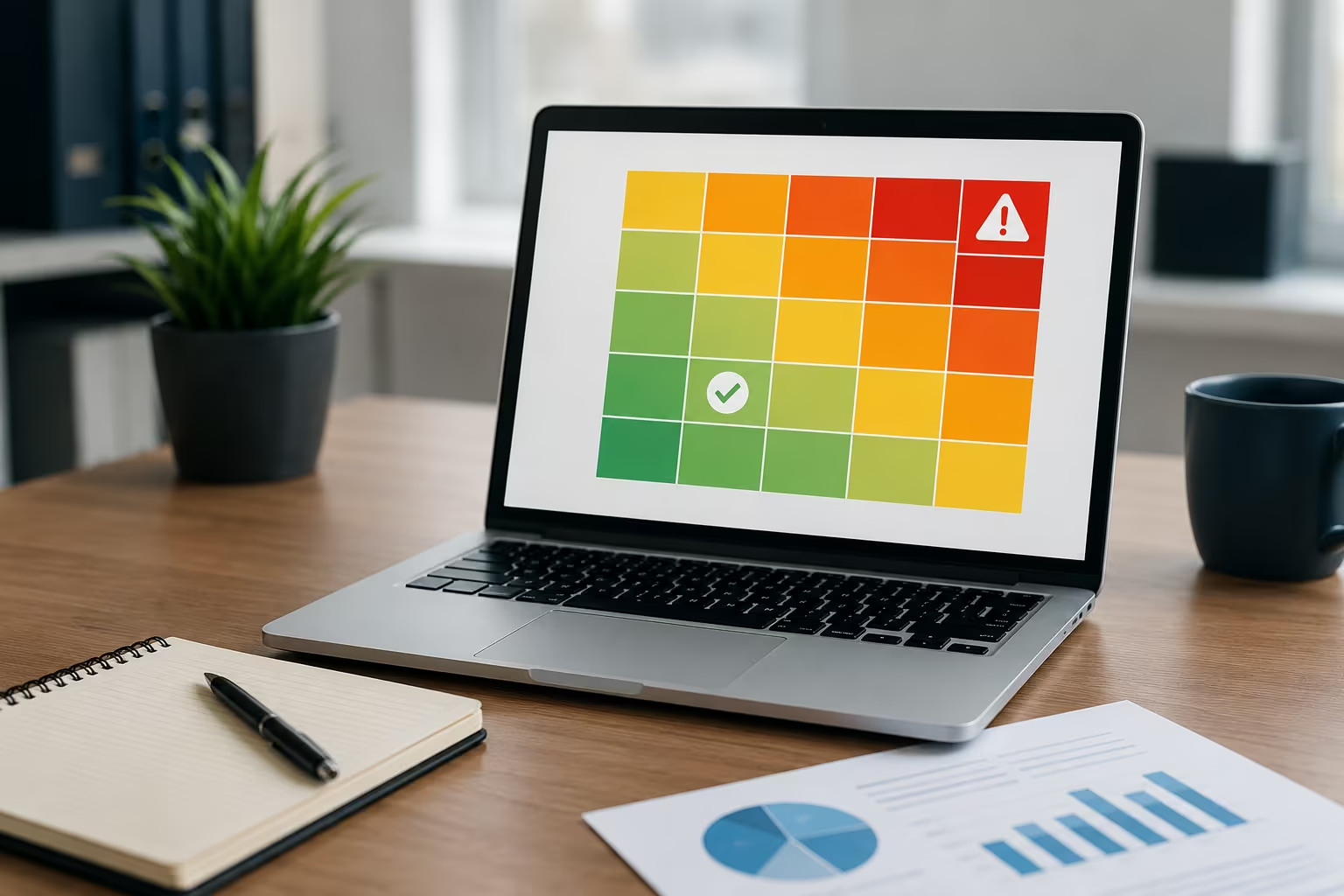
In practice, most organisations use a risk matrix to assign risks to an appropriate level. This makes it straightforward to determine which threats require immediate action and which can be monitored or accepted.
Risk assessment should not be carried out only once. Changes to IT infrastructure, new vulnerabilities and organisational growth continually alter risk levels. Assessments should therefore be regularly updated to reflect the current situation.
Which risk assessment methods should you use?
There is no single universal method suitable for every organisation. The choice depends on the sector, business size, applicable regulations and complexity of business processes.
One of the most widely used standards is ISO 31000, which sets out general risk management principles and can be applied in almost any organisation. In information security, ISO/IEC 27005 is also widely used, developing the risk analysis and assessment requirements of ISO 27001.
Organisations with more advanced cybersecurity processes also use methodologies developed by NIST, such as the Risk Management Framework (RMF). These support systematic assessment aligned with best practice.
Whatever the methodology, consistency is essential. Risk assessment should be repeatable, well documented and based on current data rather than solely on individuals’ subjective judgements.
Risk assessment and NIS2
A risk-based approach is one of the foundations of NIS2. Organisations covered by the rules should regularly identify threats, assess their operational impact and implement appropriate security measures.
This means a risk assessment cannot be a one-off document prepared for an audit. It should form part of day-to-day security management and be updated as the organisation changes and new threats emerge.
In practice, risk assessment supports many NIS2 obligations. It helps prioritise action, plan security investment and demonstrate that the organisation manages cybersecurity risk deliberately.
Further reading: What Is NIS2? A Complete Guide for Organisations.
Risk assessment and ISO 27001
Risk assessment is equally important when implementing ISO 27001. The standard requires organisations to identify information security risks and select security measures proportionate to their level.
Controls should therefore not be chosen at random. Every decision about information protection should follow from a prior risk assessment.
This approach makes more effective use of available resources and focuses activity on areas of greatest importance to the organisation. It also simplifies preparation for certification audits and demonstrating compliance with the standard.
How does risk assessment support GRC?
Many organisations still assess risk in Excel spreadsheets or scattered documents. As threats and regulatory requirements increase, this approach becomes less effective.
Modern GRC (Governance, Risk & Compliance) platforms connect risk assessment with compliance, vulnerability management, incidents and audits. All information is held in one place, making risk monitoring and management reporting significantly easier.
Centralised data enables organisations to respond more quickly to changing threats, plan remediation more effectively and make decisions using up-to-date information.
Common risk assessment mistakes
Despite growing awareness of its importance, many organisations continue to make similar mistakes. These usually arise from treating assessment as a formal obligation rather than a decision-making tool.
The most common mistakes include:
- carrying out assessments only before an audit,
- failing to update results regularly,
- overlooking business processes and focusing only on IT,
- failing to document risk reduction measures,
- ignoring new vulnerabilities and threats,
- carrying out assessments across multiple inconsistent tools.
The result is documentation that does not reflect the actual risk level or support effective security management.
A practical risk assessment example
Hypothetical example, not a customer implementation. Consider a medium-sized hospital preparing to implement the requirements of NIS2. It uses multiple IT systems, processes thousands of medical records and maintains infrastructure on which patient safety depends.
The first step is to identify the most important assets. The security team identifies the electronic medical records system, servers, network-connected medical devices, backups and network infrastructure. It then analyses potential threats such as ransomware, hardware failures, configuration errors and unauthorised data access.
The next stage is to assess the likelihood of those threats and their impact on hospital operations. This helps the organisation prioritise action and focus on risks with the greatest effect on patient safety and continuity of care.
In practice, risk assessment does not end with a report. Its findings should inform remediation planning, risk monitoring and regular updates to security measures. Many organisations use GRC platforms to centralise risk, compliance and the delivery of corrective actions.
Summary
Risk assessment is much more than a regulatory or standards requirement. It supports informed decisions about organisational security, data protection and business continuity.
Regularly identifying threats, assessing their impact and planning risk reduction measures better prepares an organisation for changing challenges. This is particularly important in the context of NIS2, ISO 27001 and modern Governance, Risk & Compliance.
Organisations that assess risk continuously and use the results in decision-making improve their resilience to incidents and readiness for audits and inspections. Integrating assessment with a GRC platform further streamlines compliance, documentation and remediation management.
