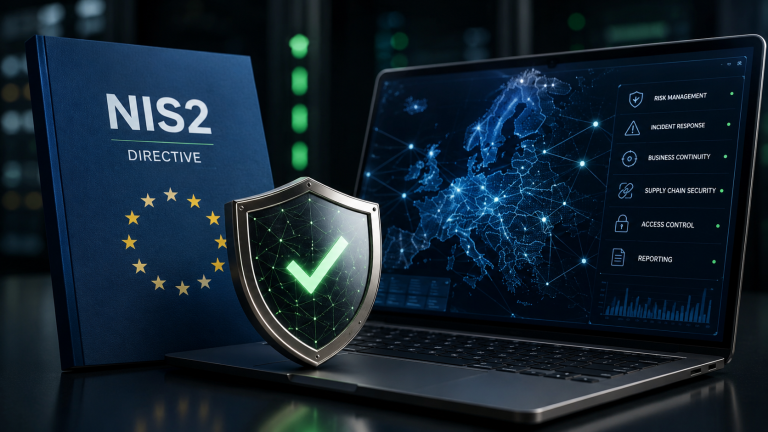

What does NIS2 mean for your organisation?
NIS2 is one of the European Union’s most important cybersecurity legal instruments. Its purpose is to improve organisational security and harmonise approaches to risk management.
In practice, many businesses ask: what does NIS2 mean for our organisation, and what should we do? The answer is not a single obligation, because it encompasses the entire security management system.
Who does NIS2 apply to?
The new rules cover a much wider range of entities than before, bringing many organisations into scope for the first time.
The directive concerns both essential and important entities in sectors including energy, water, healthcare and finance. It also covers technology companies and digital service providers. Operating in a listed sector alone does not establish coverage or entity category. In Poland, assess Articles 5 and 5a, size, legal form and exceptions. Banking and financial market infrastructure require a separate assessment of obligations. DORA provides the sector-specific ICT risk and reporting regime; Article 8i defines the Polish KSC provisions that still apply.
What obligations does NIS2 introduce?
NIS2 requires a systematic approach to security, not a one-off exercise.
Organisations must identify and assess risk, manage incidents and monitor vulnerabilities. Supplier oversight and event reporting are also required.
Technology alone is therefore insufficient: processes and management structures are essential.
NIS2 and its implementation in Poland
In Poland, NIS2 is implemented through the Act of 5 July 2018 on the National Cybersecurity System, amended by the Act of 23 January 2026 (Journal of Laws 2026, item 252), as subsequently amended.
Measures must be implemented and documented. Organisations must also maintain risk registers, prepare for audits and ensure business continuity.
Why does the traditional approach fall short?
In many organisations, security still relies on scattered tools and documents, making control significantly harder.
Obtaining an up-to-date risk picture becomes difficult, and problems arise during audits. The absence of a coherent management model also makes activities ineffective.
A more structured approach is therefore necessary.
How do you prepare a business for NIS2?
Preparation requires several steps carried out in an orderly manner.
First, identify processes and assets, then link them to risks. Next, implement incident management and vulnerability monitoring.
Finally, establish reporting and audit preparation. This helps the organisation meet regulatory requirements while improving security.
How does CyberSonar24 support NIS2 implementation?
The law requires effective processes and appropriate controls, not the purchase of a GRC platform. Such software can help organise data, document actions and support oversight, depending on the organisation’s scale.
In CyberSonar24, risk is recalculated when the record is saved as likelihood × impact. The user assesses the result and selects and documents further actions.
In CyberSonar24, one incident form includes personal data breach fields for GDPR Article 33 and notification to Poland’s UODO. Assess KSC and GDPR classification and deadlines separately. The user is responsible for submitting notifications through the appropriate channel; the form does not imply automatic submission to CSIRT or S46.
Summary
NIS2 brings significant changes to cybersecurity, requiring organisations to adapt.
👉 In practice, this means implementing risk, incident and compliance management.
CyberSonar24 can support the organisation of risk, incident and compliance information. Match its use to the organisation’s obligations and check the scope during a demonstration; the tool does not replace technical controls or legal assessment.